
Joint packaging
Review the useful joint angle, shaft or bore interface, gearing, backlash and the space around each finger joint.
Finger joints in a dexterous robotic hand leave very little space for angle feedback. Cooka’s HRS12 hollow-shaft angle sensor has a 12 mm body and a 3.2 mm profile, so it can sit around the joint shaft; magnetic and custom formats are available when the joint needs a different interface.
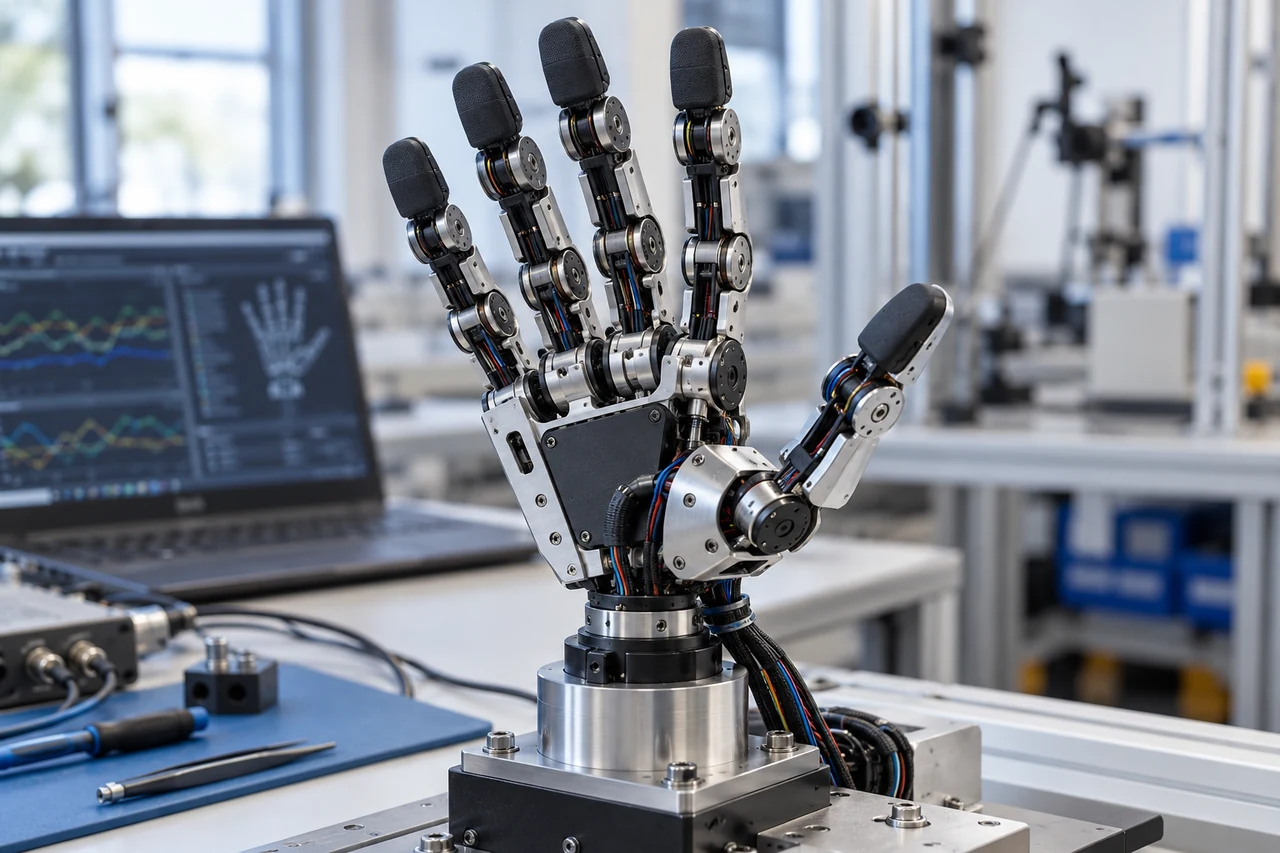
Review the useful joint angle, shaft or bore interface, gearing, backlash and the space around each finger joint.
Define the signal, response direction, repeatability and how the wiring passes through the moving finger.
Agree joint-cycle conditions, temperature, load and the calibration checks for the proposed hand assembly.
| Option | Type | Body | Profile | Linearity |
|---|---|---|---|---|
| HRS12 | Hollow-shaft angle sensor | 12 mm | 3.2 mm | 0.5% (series overview; confirm per configuration) |
| Magnetic sensing | Magnetic angle and position sensors | Per series | Per series | Confirm per series |
| Custom formats | Built to your drawing | To drawing | To drawing | To requirement |
Values are taken from the published series pages. Confirm the exact configuration, drawing revision and performance in the quotation.
The HRS12 hollow-shaft angle sensor is the usual starting point: a 12 mm body and 3.2 mm profile let it sit around the joint shaft. Magnetic and custom formats are available for other joint designs.
The HRS12 has a 3.2 mm profile and a 12 mm nominal body, with an alloy housing.
Yes. Send the joint drawing, angle, interface and wiring requirements for a configuration review.
The minimum order quantity starts at 10 pieces for standard configurations; custom configurations are quoted per project.
Lead time is 3–7 days for in-stock configurations.
Yes. Cooka provides free samples for qualified projects.
Send the model, drawing or application. Cooka engineers will review the configuration with you.