
Cooka engineering · Materials · Updated 24 October 2026
The short answer
The resistive element decides most of a potentiometer’s cost, feel, life and stability. Carbon film is the cost-effective all-rounder with a wide resistance range and smooth output, and suits most control and feedback applications. Conductive plastic is chosen for very long life and very smooth, low-noise output in precision sensors. Cermet is chosen for temperature stability and power handling, typically in trimmers and harsh environments. Cooka specialises in carbon film and develops its own carbon-film formulations in-house.
What each material is
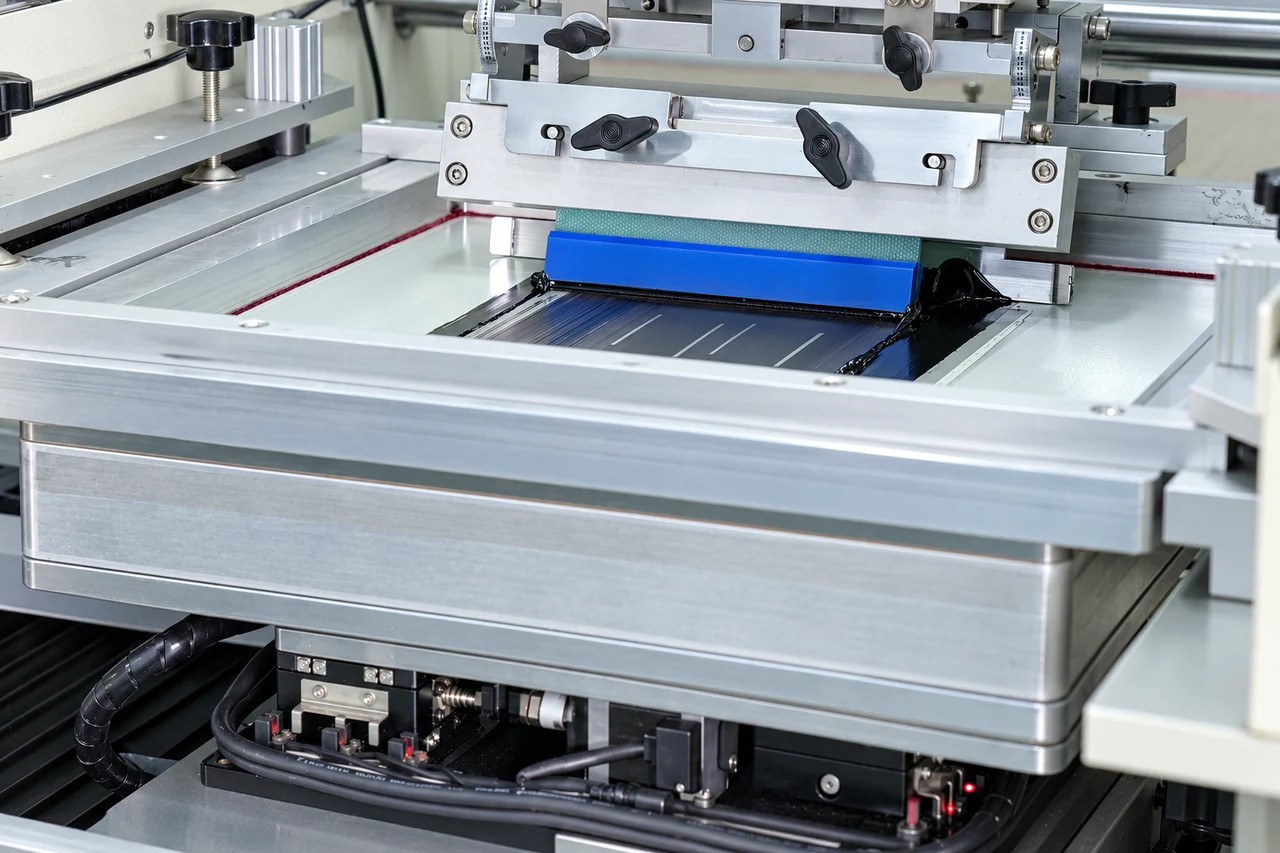
- Carbon film: a carbon-based resistive ink printed onto a substrate and cured. The formulation and print pattern set the resistance and the response curve.
- Conductive plastic: a carbon-loaded polymer track with a very smooth surface, designed for long wear life and fine resolution.
- Cermet: a ceramic–metal composite fired onto a ceramic substrate. It tolerates high temperature and power but is harder and rougher for the wiper.
How they compare
| Property | Carbon film | Conductive plastic | Cermet |
|---|---|---|---|
| Cost | Low | High | Medium |
| Resistance range | Wide | Medium | Wide |
| Smoothness / resolution | Good, effectively continuous | Excellent | Fair |
| Rotational life | Good; depends on formulation and design | Very long | Shorter |
| Temperature stability | Moderate | Moderate to good | Very good |
| Power handling | Moderate | Moderate | High |
| Typical uses | Controls, joysticks, audio, industrial and automotive feedback, custom elements | Precision position sensors, long-life faders | Trimmers, high-temperature and high-power circuits |
General comparison. Actual values depend on the specific formulation, substrate and construction; always compare datasheets.
When carbon film is the right choice
Carbon film is the sensible default when you need a reliable resistive element at volume cost and the application does not demand extreme life or extreme temperature stability. That covers most rotary controls, joysticks, faders, actuator feedback and automotive position sensing.
Carbon film is also the most adaptable material for custom work: the formulation, track width and print pattern can be tuned to hit a target resistance, a specific taper or a non-standard element shape.
How far carbon film goes in practice
A carbon element does not have to mean short life or loose tolerance. Examples from Cooka’s published series:
- CRS16: 16 mm carbon-element potentiometer, 200 Ω to 500 kΩ, IP65.
- RVR22: 22 mm carbon-element series, 200 Ω to 100 kΩ, IP65, selectable electrical angles.
- SRS22: 22 mm precision rotary potentiometer rated for 5 million no-load cycles (10 million option) with linearity options down to ±0.25%.
Life, linearity and temperature behaviour always depend on the full design (element, wiper, bearing and housing), so compare the series datasheet rather than the material name alone.
When to choose something else
- Choose conductive plastic when the specification calls for tens of millions of cycles or ultra-smooth, low-noise output, and the budget allows it.
- Choose cermet for set-and-forget trimmers, high power or sustained high temperature where the wiper rarely moves.
Why Cooka focuses on carbon film
Cooka develops carbon-film formulations in its own materials laboratory, prints and processes the resistive elements, then machines, assembles and tests the finished components in Zhongshan, China. Controlling the material lets Cooka adjust resistance, taper and element geometry for a customer’s drawing instead of only offering catalogue parts. See carbon-film resistive elements and custom engineering.
- MOQ
- From 10 pcs standard configurations
- Lead time
- 3–7 days stock items
- Samples
- Free qualified projects
- 3D model
- STEP on enquiry
FAQ
What is the difference between carbon film and conductive plastic potentiometers?
Carbon film is a printed carbon-based element: low cost, wide resistance range and smooth output. Conductive plastic is a carbon-loaded polymer track chosen for very long life and very smooth, low-noise output, at a higher cost.
When should I use a cermet potentiometer?
Use cermet for trimmers and circuits that need high power handling or stability at high temperature, where the wiper is adjusted rarely.
Are carbon film potentiometers durable?
Durability depends on the full design. For example, Cooka’s SRS22 is rated for 5 million no-load cycles, with a 10 million-cycle option.
Does Cooka make conductive plastic or cermet potentiometers?
Cooka specialises in carbon-film elements, developed and printed in-house. Send your requirements and Cooka will advise whether a carbon-film design can meet them.
What is the MOQ and lead time for Cooka potentiometers?
The MOQ starts at 10 pieces for standard configurations and the lead time is 3–7 days for in-stock configurations. Free samples are available for qualified projects.