
Cooka engineering · Component selection · Updated 24 October 2026
The short answer
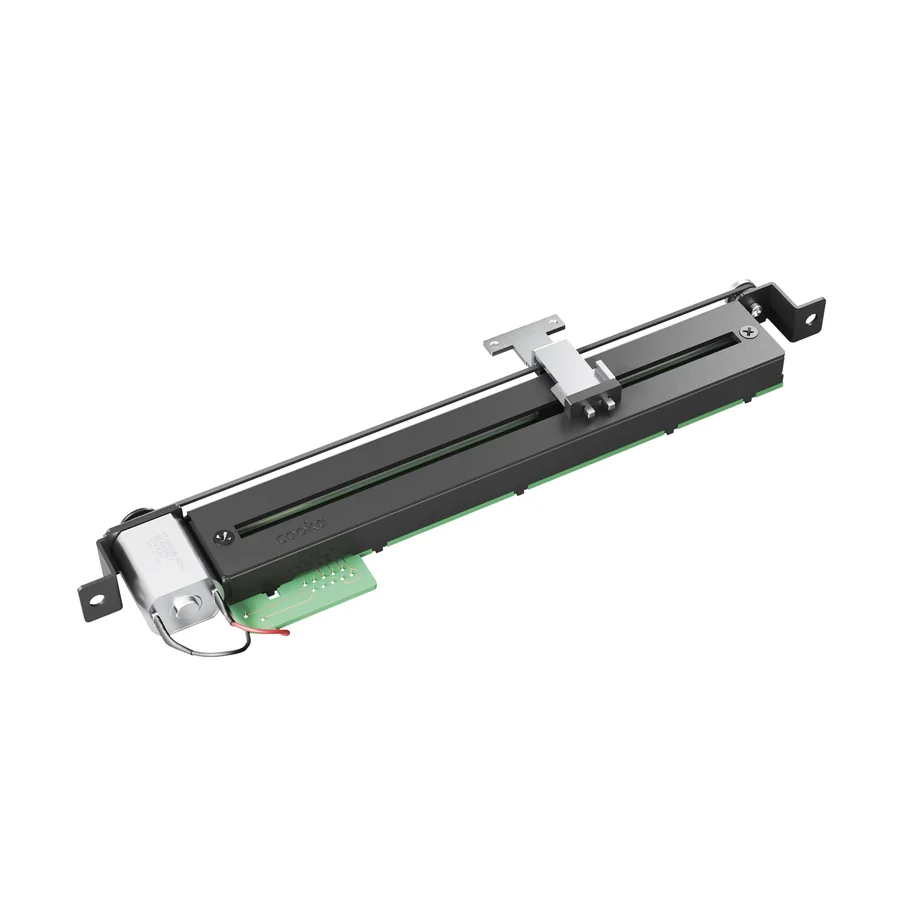
A motorized fader is a slide potentiometer with a small DC motor that can move the lever to a stored position. Choose one by checking six things in order: whether you really need motor movement, travel length, resistance and taper, linearity, service life, and the lever, connector and motor-drive arrangement. Cooka’s MSV02 and MSV05 are motorized faders in 60 mm and 100 mm travel; the SVR01 is the manual alternative.
1. Do you need a motor at all?
A motor is needed when the system, not only the operator, must set the lever position. Typical cases are mixing consoles that recall scenes, DAW controllers that follow on-screen automation, lighting desks that load cues, and remote-controlled panels.
If the lever only ever moves by hand, a manual slide potentiometer is simpler, smaller and cheaper. The SVR01 covers 45, 60 and 100 mm travel with single or duplex tracks and light or heavy operating feel.
2. Travel length: 60 mm or 100 mm
Travel decides how finely an operator can set a value and how much panel space the fader needs. A 100 mm travel gives the long, precise throw expected on full-size console channels. A 60 mm travel suits compact controllers and secondary controls. Both the MSV02 and MSV05 are offered in 60 mm and 100 mm.
Start from the panel layout: channel pitch, panel opening and the depth available below the panel.
3. Resistance and taper
Both Cooka motorized faders are offered in 5 kΩ and 10 kΩ with a linear taper. In a motorized fader the controller reads the position through an analog-to-digital converter, so a linear track is usually the right choice; any audio-style curve can then be applied in firmware.
Choose the resistance to suit the reference voltage and input impedance of your converter, and keep it consistent across channels.
4. Linearity and repeatability
Linearity tells you how closely the output follows the lever position. It matters when the motor must return the lever to the same place every time a scene is recalled.
- MSV05: ±2% maximum linearity.
- MSV02: ±2.5% maximum as standard, with ±1.5% and ±1% ordering options.
If the system compares the read-back position with a target, define the tolerance you need before choosing.
5. Service life
Life is stated as no-load operating cycles. The MSV05 is rated for 2 million cycles (1 million with the L order code); the MSV02 for 1 million cycles. Motorized faders on automated channels can move far more often than a manual control, so estimate cycles from the automation, not only from human use.
6. Lever, connector and motor drive
These details decide whether the fader drops into your design without rework.
- Lever: MSV02 offers T or TL levers; MSV05 offers T, TL and TA levers. Match the lever to your knob and panel height.
- Connector: MSV05 is available with an FFC-1.0-10P or a PH-7P connector.
- Motor drive: plan the motor driver and supply on the controller board. The element’s 200 VDC maximum input voltage is a rating for the resistive track, not for the motor.
- Touch sensing: if the design stops the motor when the operator touches the knob, confirm the touch-sense arrangement for the selected configuration.
- Environment: both models are specified for −10 to +70 °C operation.
MSV02 vs MSV05 vs SVR01
| Model | Type | Travel | Resistance | Linearity | No-load life | Options |
|---|---|---|---|---|---|---|
| MSV05 | Motorized | 60 / 100 mm | 5 / 10 kΩ | ±2% max. | 2 million cycles | T, TL, TA levers; FFC or PH connector |
| MSV02 | Motorized | 60 / 100 mm | 5 / 10 kΩ | ±2.5% max. (±1% option) | 1 million cycles | T or TL lever |
| SVR01 | Manual | 45 / 60 / 100 mm | 5 / 10 kΩ | ±3% max. | 1 million cycles | Single or duplex; light or heavy feel |
Values from the published series pages. Confirm the exact order code and drawing in the quotation.
What to send Cooka
- Manual or motorized, and how often the motor will move the lever.
- Travel length and panel layout.
- Resistance, taper and single or duplex track.
- Lever style, knob and connector.
- Motor driver, supply and touch-sensing plan.
- Expected annual quantity and sample timing.
- MOQ
- From 10 pcs standard configurations
- Lead time
- 3–7 days stock items
- Samples
- Free qualified projects
- 3D model
- STEP on enquiry
FAQ
What is a motorized fader?
A motorized fader is a slide potentiometer with a small DC motor that can move the lever to a stored position, so a console or controller can recall settings automatically.
What travel lengths do Cooka motorized faders come in?
The Cooka MSV02 and MSV05 motorized faders are offered in 60 mm and 100 mm travel.
What is the difference between the MSV02 and MSV05?
Both offer 60 or 100 mm travel and 5 or 10 kΩ resistance. The MSV05 has a 2 million-cycle no-load life, ±2% maximum linearity, T, TL and TA levers and FFC or PH connectors; the MSV02 has a 1 million-cycle life and ±2.5% maximum linearity with ±1.5% and ±1% options.
Should a motorized fader use a linear or log taper?
A linear taper is usually best, because the controller reads the position digitally and can apply any response curve in firmware.
What is the MOQ and lead time for Cooka faders?
The MOQ starts at 10 pieces for standard configurations and the lead time is 3–7 days for in-stock configurations. Free samples are available for qualified projects.